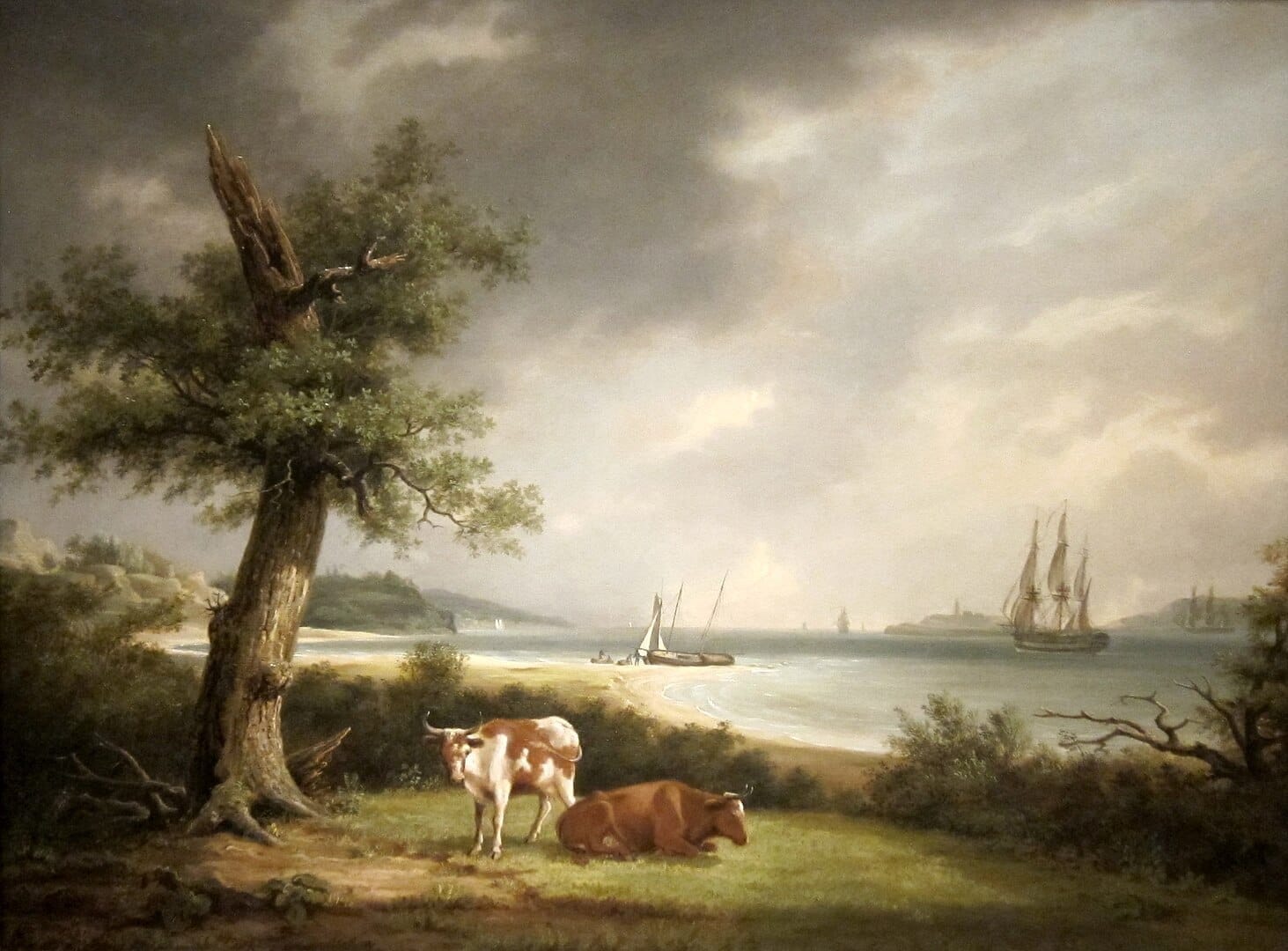
In the 1600s, people from around the world began collecting on the archipelago of islands that would become New York, killing and driving off the people who had been here for thousands of years, and eventually building the most cosmopolitan city in history.
While Toronto and London are lauded for their multiculturalism, about 300 languages are spoken on their streets on any given day. In New York City, that number is more than 8o0.
There has never been a more culturally and linguistically dense place in human history, and our species is better for it. (And maybe worse too.)
There's a million wonderful ways to illustrate this swashing and swirling, but my favorite is the land itself.
During the last ice age, the Laurentide ice sheet covered Canada and the Northern US, reaching as far south as New York, pushing huge amounts of land and dirt into a terminal moraine, or a mounding at it's leading edge. Around here, this is known as the Harbor Hill Moraine, which added some height to Long Island, and created a wall that stretched across Staten Island and into New Jersey.
Then, as the ice retreated, the low points began to fill with more and more water.
About 13,350 years ago, part of this glacial moraine broke open at the Verrazano Narrows, allowing water to escape into the Atlantic Ocean.
For thousands of years, water flowing in and out of this narrow channel scoured a deep rut in the ocean floor.
6,000 years ago, most of the ice sheet had melted, and sea levels had risen dramatically, creating the modern archipelago where millions of us live today.
And every day millions of gallons of fresh water flow down the rivers trying to make it to open ocean and are met with millions of gallons of sea water trying to pump into New York Bay through the Narrows.
The result is incredible sloshing and swirling and mixing, creating one of the most brackish bodies of water on earth.
This gave New York an advantage over other nearby ports. The harbor was less likely to freeze, meaning that NYC was open for trading year round, while in the 1700s and 1800s, Philly had to wait for the ice to thaw.
The Verrazano Narrows is more than the gateway to the New World. It's also a battle between two competing and also cooperative forces - fresh water going out, and sea water going in, navigating this flow like New Yorkers navigate 5th Avenue at rush hour.
Geography is often forgotten in modern contexts, but it's the stage upon which our dramas play out.
And you have to wonder, if the great mixing of New York City really ever could have happened anywhere else.
Image Credit: The Narrows of New York Bay. 1812. Thomas Birch via Wikipedia. Ships sail in and out of the harbor through the narrows, while cows rest on the banks of Staten Island.
Zoink!
Sign up for our free email list full of colorful images and provocative ideas. You'll get more honest and thoughtful stuff like this, and you'll also get notified when there's a meeting of the Sunday Wander Society.
No spam. Unsubscribe anytime.
The link has been copied!